Why There's No Such Thing As 'Authentic' Curry
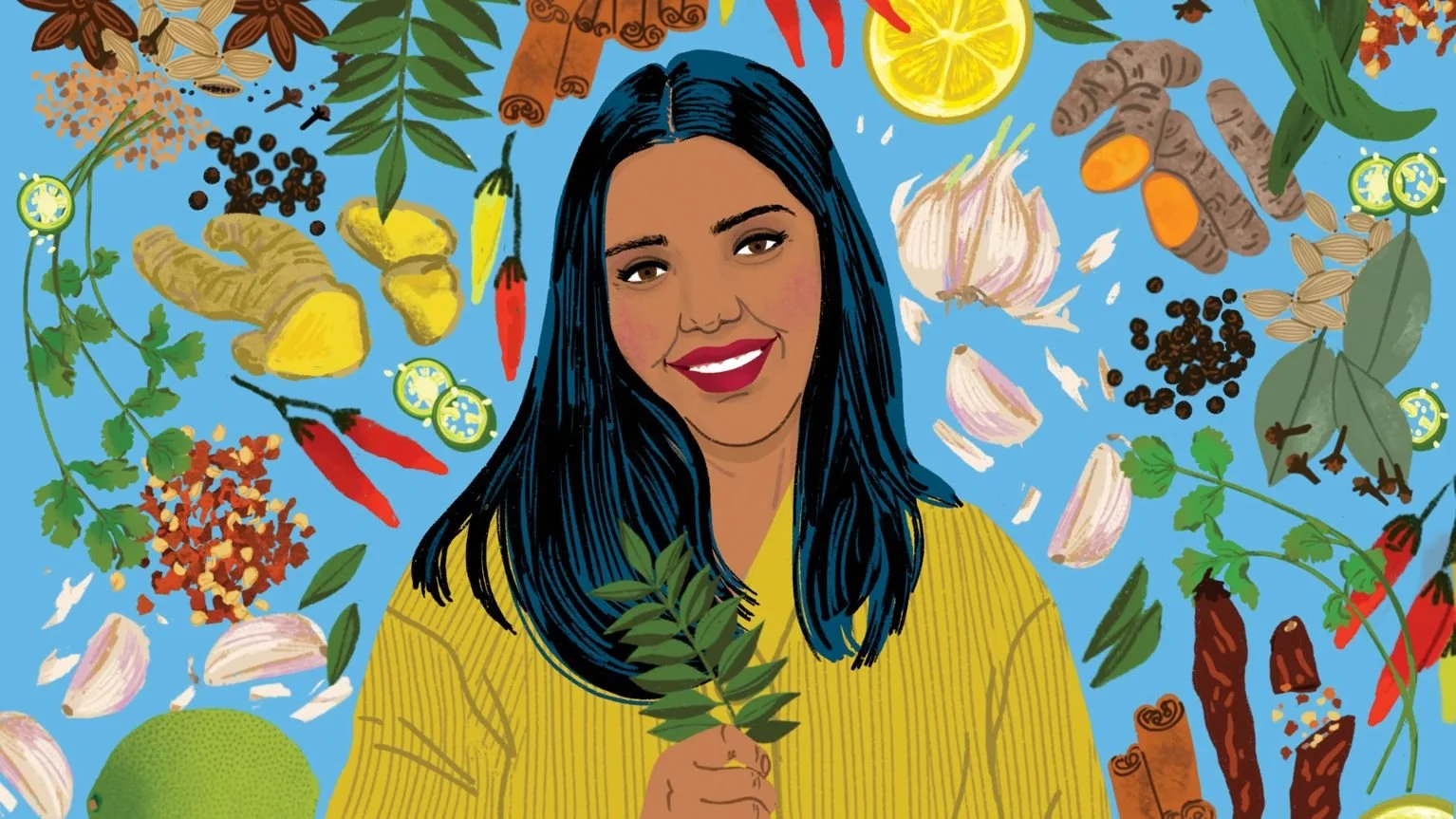
Illustration by Salini Perera via Chatelaine
In the decade-plus since I moved to North America from Jaipur, India—first to New York City, then to Vancouver—every visit I’ve made to an Indian restaurant involves the same ritual. I’ll open the menu, skim the appetizers and brace myself for the small, sinking feeling when I see one catch-all heading: Curries.
Sometimes, the section includes diaspora staples: chicken tikka masala, butter chicken, vindaloo. Other times, it corrals distinctly regional dishes under the same generic category, differentiated only by protein, vegetable or heat level. It even appears on the most sophisticated, niche and regionally specific menus. I’ll find things like Alleppey jhinga, a prawn coconut dish from Kerala, and Punjabi chholay, a north Indian preparation for chickpeas, grouped together despite being dishes with entirely different cooking techniques and histories.
"It’s oddly comedic seeing an entire subcontinent’s myriad cuisines squeezed into a single sauce. I order anyway, of course, knowing that the curry rubric isn’t meant to be accurate—only digestible, convenient and reassuringly familiar to Western expectations.
Curry—the ubiquitous golden-orange gravy heavy with butter or cream and built around a familiar protein—has become the poster child of South Asian diaspora cuisine. But it’s not native to most of the dishes it describes. It’s a colonial invention shaped by ignorance and convenience. When the Portuguese arrived on India’s southwestern coast in the early 1500s, they used the word caril to describe the spiced stews and sauces they encountered—likely borrowing from kari or karil, a word rooted in Tamil and Malayalam languages for a specific preparation (not a cuisine). The British later anglicized the term to curry, creating a catch-all that came to represent countless regional dishes. As empire-building and migration carried the word outward, it took on new meanings. The word appeared in British curry houses, Caribbean kitchens, Japanese roux blocks, Thai menus and supermarket spice aisles—each iteration further loosening any connection to a specific place, practice or technique. What began as colonial shorthand has since ballooned into a globe-spanning category, shaping how South Asian food is understood, sold and consumed today.
Aman Dosanj, a storyteller and chef who lives in Kelowna, B.C., puts it bluntly: “For [our] to get branded as this monolithic thing is frustrating.” This frustration echoes across kitchens and food scholarship alike. The late chef and author Raghavan Iyer once joked on the podcast Gastropod that it feels as though “there’s a gnome sitting under a tree somewhere stamping out cookie-cutter menus.” Mauritian-Canadian writer Naben Ruthnum, in his book Curry: Eating, Reading and Race, describes curry as “an Indian fairy tale composed by cooks, Indians, émigrés, colonists, eaters, readers and writers.”
In Canada, popular Indian restaurants from coast to coast—including Vancouver franchises such Sula and Tasty Indian Bistro, and Adrak and Khazana in Toronto—use the term for a wide range of dishes. While Dosanj understands that the exoticization of one’s home cuisine comes from a need to translate it into a universal format most diners can understand, and a need to “pay the bills,” she says that “Indian restaurants haven’t done themselves justice.” Chef Vish Mayekar of Vancouver’s Elem restaurant adds that while educating diners about different cuisines and the origins of each dish is more important than ever, it can be a huge challenge for restaurateurs who are just trying to run a business in the current economy.
For the home cook, the proliferation of store-bought curry powders has only muddled things further. Instead of coaxing flavour from whole spices through slow toasting, grinding, blooming and layering, many recipes call for pre-mixed spice blends. That shortcut sacrifices technique—the quiet, foundational knowledge that gives Indian food its structure and soul. Consider tadka, the deceptively simple process of briefly frying whole or ground spices, aromatics like garlic or ginger, and dried chilies in hot oil or ghee before adding lentils and vegetables to the fragrant mixture. The timing matters. The temperature matters. Whether the cumin seeds crackle or burn, whether the garlic turns sweet or bitter, whether the oil carries heat or restraint—each little decision in the preparation can mean the difference between a good dal or a great one.
There’s more. Rather than being sprinkled in for colour at the end, turmeric is usually added early as the lentils cook. It then blooms gently in hot water and fat, lending earthiness and bitterness while also aiding digestion and offering anti-inflammatory benefits. The role is practical and symbolic at once—grounding, medicinal, elemental—woven into a staple dish eaten daily in countless Indian households.
Reduce all of that to “curry,” and Indian cooking is no longer a cuisine of precision, wisdom and technique, but one defined by a single colour or spice profile. “It dilutes the knowledge of those hands of your bibbi—that’s instinctual, without recipes—grabbing and pinching spices from the masala dani [spice] and pouring it into your dishes,” Dosanj explains. “Ours is such a technical cuisine if you do it right.”
Undoing curry and overturning centuries of colonial dilution is a tall order, but small efforts can make a difference. For diners, that can mean asking where a dish comes from, or seeking out restaurants that try to name and honour regional traditions. For cooks and food businesses, it might look like resisting the urge to shoehorn dishes into a single category, or trusting customers enough to let a dish be specific, even if it requires a sentence of explanation. And for all of us, it can be as simple as paying attention to the quiet grammar of spices and techniques that tell stories more nuanced than the word curry ever could.
After all, the happy, energized feeling you get after eating spicy Indian food comes from more than just heat. It’s from the interplay of sweet, spicy, savoury, tangy and sour; the crunch of onions or cumin seeds or whole chillies bloomed in hot oil. It’s from the familiar burn that lingers at the back of your throat as you pause, gasping and exhilarated between open-mouthed bites, only to reach for another.
This story originally appeared in the Spring 2026 issue of Chatelaine.